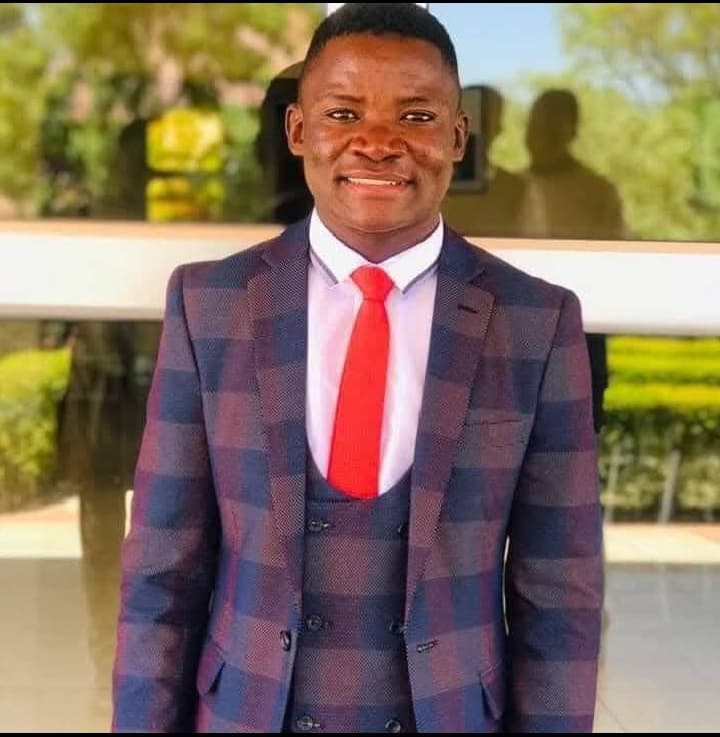

Gerry Sikazwe
About the Author
- What would you want people to know about you?
I am author of poetry collections ‘Words That Matter’ (2018), ‘Take Me With You’ (2020), forthcoming ‘Umutolilo Wa Nsele’ (2026), an Ici-Bemba poetry collection. I have published my works in several anthologies notable being ‘Best New African Poets’ (2018) by Mwanaka Media and Publishing, ‘Sister Wives & Other Short Stories’ (2021) by Myaambo, ‘Generational Discordance: Ake Arts & Book Festival Review Volume 8 (2021), ‘Old Love Skin: Voices From Contemporary Africa’ (2022) by @Mukana Press, ‘Canvas of Truth’ (2023) by Sheba Lishika-Dzekedzeke which won a 'Most Outstanding Poetry' Ngoma Award, and ‘Canto Planetario’ (2023) by Carlos Jarquín. And I have been published in several other literary journals and magazines on the web.
- Are there any type of writers you would like to connect with for shared experiences?
I am intrigued by Zambian poets of old, so those are top on my list and also Zambian writers and poets in the diaspora. The latter, I believe have a lot to share on how to get Zambian stories in front of global audiences.
- What is your nationality and location?
Zambian, and I currently live in Lusaka.
Background/Education:
- Give a brief overview of your backstory.
I was born in Kasama, and we soon after move to Lusaka, Lusaka West to be exact, where I spent most of my early years.
- What is your educational background?
From Pre-school to Junior Secondary, I went to school in Lusaka Province, and for my senior secondary school I attended Mungwi Technical Secondary School in Northern province. For undergraduate studies, I read Adult Education at the University of Zambia where I am currently pursuing postgraduate studies in Communication for Development. I am concluding studies for a postgraduate diploma in Public Relations and Communication at the Zambia Institute of Mass Communication Trust (ZAMCOM).
- What qualifies you for your writing?
For my writing, life’s unanswered and unanswerable questions prompt it. My writing is qualified by my reading other writers’ works during my foundational years, running my high schools magazine, running one of Zambia’s first online literary journals, having my work published in others’ journals, to countless literary craft courses and days and nights of reading the written word.
Inspiration:
- What do you write?
I mainly write poetry and short fiction, avenues I use to answer and ask questions, to learn and teach.
- Why do you choose to write?
I write to add to life; to form and reform life. The act of writing for me is both a process of being in communion with my enerst and purest self, and it is also in interaction with ideas and the world outside my heard. In a world full of noise and fast-moving pieces, writing is a calming and slowing down of life.
- Are there any special influences in your life that drove you to writing?
My father is the first influence. Him and my mother encourage me into reading at a very tender age, and seeing my father write poems for me to recite in church encouraged to write too. Professional writing was honed by Dale P. Wimbrow’s ‘The Man in the Glass’ poem I found in one of Dad’s books. Later Langston Hughes, Louis Robert Stevenson, Maya Angelou, and Emily Dickinson, and other writers have since nurtured my writing.
- What drives you to keep writing?
At this point, I cannot shut the poems off. I see poetry in everything, the famed muse speaks to me in the most ordinary of situations. For a deeper answer, I would say, my need to share information, knowledge, my rumblings or points of view, but honestly it is how I think, how I see and attempt to understand the world and life, in general. It is bound to happen one day or the other as it is who I am.
- What inspires your type of writing?
For poetry, I love writing short form poems and this is consisted with the artistry of Langston Hughes and Emily Dickinson that I was exposed to in Grades 10 through 12. However, I have always had a ‘search for knowledge/question knowledge’ predisposition and that is commonly placed in my work.
- What challenges have you faced in your writing journey?
The biggest challenge has been managing writing and publishing. With writing, usually every element of this practice relies on the writer but publishing (from writing to selling written work) that has many other factors usually beyond the writers immediate control.
- How do you handle negativity from readers?
I am proud of my work, but I have always had openness to hearing others views. Over the years I have gotten to develop how to react to negative comments from a progressive standpoint: hear them out, see if there is merit and leverage it to improve. This I have done with several reviews I have gotten for my previous publication.
- Have your readers ever made any suggestion to you? If yes, are you able to share them here for the benefit of everyone?
The late Wampembe Lukonde in his then ‘Of poets and poems’ column in the Times of Zambia featured and reviewed some works back in 2017 and he advised that I read more literary works because he felt my work lacked technique and variety. Another book reviewer, a friend, Ms Marjorie Moono Simuyuni lamented about my titles being weak, and this was so true that I started investing more attention to titling my work and today, I can confirm that I am better at titling.
- What do you consider the best writing you ever read and what, in your opinion, makes it so interesting?
There is so much to pick from. But I will mention a few, Mubanga Kalimamunkweto’s short story ‘Inswa’ was original and bold, attempting to discussing an issue in the open that is most only spoken of in whispers in closed spaces. Charles Chanchari’s uber-centred short story ‘Around Nairobi in One Night’, yet another original, timely, and yet unexpected story told in the style of a play. Sharon Olds’ ‘Satan Says’ is an intriguing poem that challenges boundaries of speech, and ‘The Trees’ by Philip Larkin, is a beauty like no other, discusses passage of time in beautiful language easy on the tongue and ears. There is so much to mention, but in all, a good writing moves the needle, pushes past the set boundaries and not always in a grand way but in a way that is recognisable, that scratches an itch whether identified prior or after.
- If you have done any writing, what do you consider the best work you ever did and why? Are there any new standards you are aiming at now to go higher than this level?
Embarrassingly so, my best writing came in the book ‘Take Me With Me’ and it is about a love withdrawn. My next level is to write more about self, to look within and see what I have stored, starved, or buried in there, and to be more observant and curious about the invisible threads that all life and worldly conduct is wrapped in. There are truer tales beyond and besides those of love. I now want to find them, and share them in my writing too.
- Are there subjects you feel Zambians should write more about? If yes, which subjects and why?
Cultural subjects for one should be priority, whether we are celebrating culture or exorcising it for some of its evil ways. Another form that must be encouraged beyond redacted news articles is subjects of political nature, questions should asked and answers demanded, but above all people should realise that expression is the truest form of freedom, participation and ultimately development. In a country like ours, made of many grains sand, multi-ethinic subjects like some Zambian writers of old did, including that multi-lingua effect to their narratives, characters, and so on.
- What do you do to make sure that the message in your writing is received by most of your intended audience?
I do not set out to be understood by all, so I go for what is relatable, sometimes it means adopting phrases that are common, and other times it means picking issues that majority of people have encountered. Resonance is the key to any shared outcome, so usually I just report back to the intended audiences; even if I am teaching a new thinking or approach I present it as a report of an account they have been witnesses to.
- Has your writing helped you economically? If yes, how did you achieve it? (You are not obliged to answer this question.)
Yes, it has. Writing has the creative side and the business side, the key as in any business is to know who is buying and what are they buying. First, submitting written work to some journals and literary magazines pays, and I get paid that way. Secondly, book sales have helped me achieve some financial goals in the past. As a poet, I have also performed my poetry at certain conferences and paid for that too. However, note that, the ‘writing’ market is not well structured in most cases and in the cases when it is structured you need to better infrastructure like a literary agent, strong portfolio, and at times an even better reader base. Economic benefit from writing is affected by a number of realities, so have a working marketing, distribution, and value addition plan.
- What do you hope to have accomplished when all your writing is done?
Through all my writing, I should leave the world brighter. My writing should have cast light on areas that would have otherwise remained (in the) dark. By so doing, I would have helped in one person to take a step into the right direction knowing the path has been lit and they can see where they are stepping.
Hobbies:
- What do you love doing aside from writing?
Learning new things, currently I am learning how to play the guitar.
- What are your past projects?
‘Words that Matter’ and ‘Take Me With You’
- What are your ongoing commitments?
‘Here Is A Painting’, ‘Umutolilo Wa Nsele’, and others.
Suggestions:
- Is there anything you wish changed in the Zambian writing/publishing landscape, and what change, if any, would you suggest?
An improved book distribution channel in-country, continentally, and internationally. The Government, National Arts Council, publishers, and writers’ associations, can organise international Zambian book showcases alongside embassies across the globe. Imagine a book fair at the US Embassy in Lusaka for Americans in Zambia or the Zambian Embassy in the USA for Americans literary associations to discover our works.